A glimpse of history
Source: Asia Insurance Review | Jan 2026
With Asia Insurance Review celebrating its 35th anniversary this year, we felt that it was apt for us to look back at our earlier issues and see how we have developed as a publication, and also get snapshot of the industry from years past. This month, we take a look at the first ever Letter from the Editor from our original Editor-in-Chief Mr Sivam Subramaniam, as well as a collection of welcome messages from various members of the industry across Asia.
|
The article is reprinted, as is.
|
From the Editor’s Diary
This is indeed a great moment to witness the birth of Asia Insurance Review.
I must confess that the enormity of the task to come out with a trade journal serving the insurance industry was daunting at first. But apprehension soon turned to commitment as I felt the enthusiastic support of the insurance community to the idea.
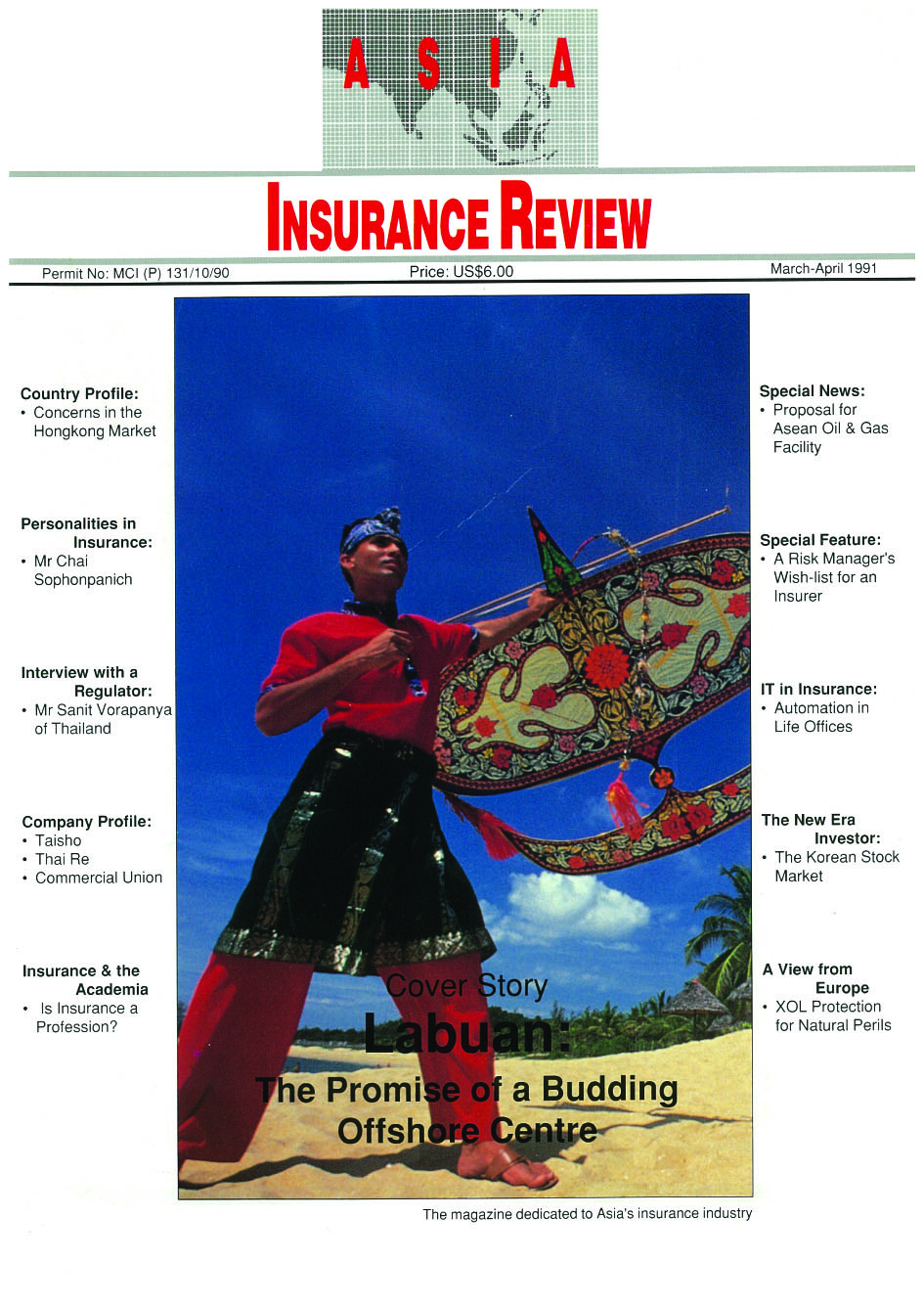
My testing ground as to the viability of the idea was the East Asian Insurance Congress in Taipei, which forms the fitting cover story of this launch issue. Many professionals lamented the dearth of information about Asia’s insurance industry. Some stressed the need for a regional magazine to help plug the Asian insurance industry into the international grid as the insurance business was becoming highly internationalised. Others said this was particularly important at a time when global attention was being focused on the growth prospects in the Asia Pacific. Most people called for a publication that will boost the two-way flow of information between Asia and the other regions in the world.
Borne of these motivations, Asia Insurance Review, which incorporates the 20-year-old Philippines-based “Insurance Asia”, aims to meet the information needs of the insurance practitioners in Asia in particular and the rest of the world in general.
As the next century promises to be even more challenging, Asia Insurance Review will endeavour to contribute to the industry’s march towards higher stndards and greater professionalism by making people more aware of trends and developments around the region and elsewhere in the world. Towards this end, Asia Insurance Review will offer a bi-monthly fare including country focus, companies profile, personality highlights, technical developments in the insurance business as well as regular features like the new era investor and information technology in insurance.
As this is a magazine dedicated to Asia’s insurance industry, we hope over time to be respected as a journal of record that boosts the profile and business prospects of the Asian industry globally. The demands are greater now as competition in the region and the rest of the world is increasing rapidly.
Our vision is to give the insurance industry a comprehensive trade journal it can be proud of. Asia Insurance Review is here to stay and grow with the industry. We hope to enjoy your lively support and active cooperation.
Editor
Sivam Subramaniam
|
 |
Messages
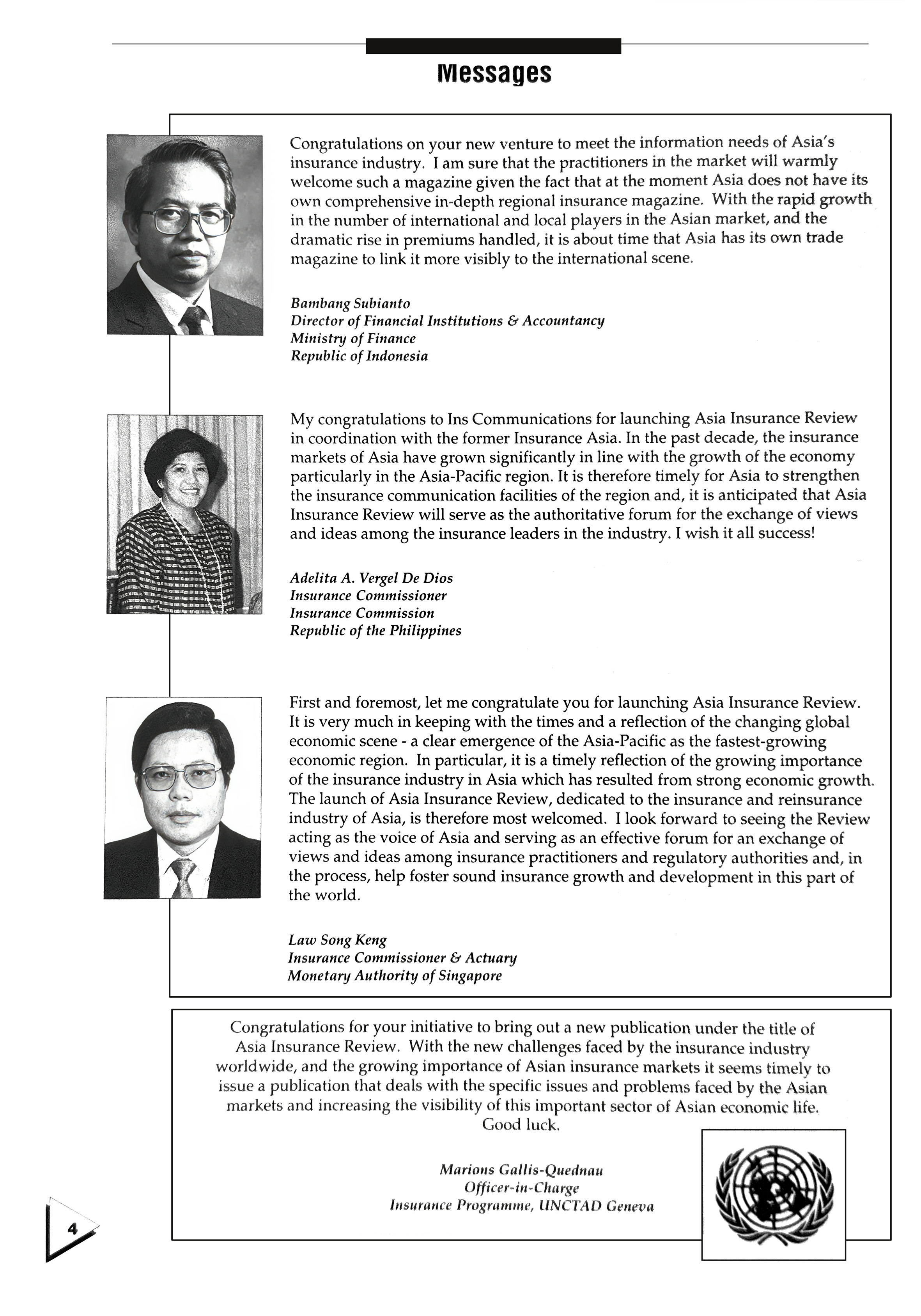
Congratulations on your new venture to meet the information needs of Asia’s insurance industry. I am sure that the practitioners in the market will warmly welcome such a magazine given the fact that at the moment Asia does not have its own comprehensive in-depth regional insurance magazine. With the rapid growth in the number of international and local players in the Asian market, and the dramatic rise in premiums handled, it is about time that Asia has its own trade magazine to link it more visibly to the international scene.
Bambang Subianto
Director of Financial Institutions & Accountancy, Ministry of Finance,
Republic of Indonesia.
My congratulations to Ins Communications for launching Asia Insurance Review in coordination with the former Insurance Asia. In the past decade, the insurance markets of Asia have grown significantly in line with the growth of the economy particularly in the Asia-Pacific region. It is therefore timely for Asia to strengthen the insurance communication facilities of the region and, it is anticipated that Asia Insurance Review will serve as the authoritative forum for the exchange of views and ideas among the insurance leaders in the industry. I wish it all success!
Adelita A. Vergel De Dios
Insurance Commissioner Insurance Commission, Republic of the Philippines
|
 |
First and foremost, let me congratulate you for launching Asia Insurance Review. It is very much in keeping with the times and a reflection of the changing global economic scene a clear emergence of the Asia-Pacific as the fastest-growing economic region. In particular, it is a timely reflection of the growing importance of the insurance industry in Asia which has resulted from strong economic growth. The launch of Asia Insurance Review, dedicated to the insurance and reinsurance industry of Asia, is therefore most welcomed. I look forward to seeing the Review acting as the voice of Asia and serving as an effective forum for an exchange of views and ideas among insurance practitioners and regulatory authorities and, in the process, help foster sound insurance growth and development in this part of the world.
Law Song Keng
Insurance Commissioner & Actuary, Monetary Authority of Singapore
Congratulations for your initiative to bring out a new publication under the title of Asia Insurance Review. With the new challenges faced by the insurance industry worldwide, and the growing importance of Asian insurance markets it seems timely to issue a publication that deals with the specific issues and problems faced by the Asian markets and increasing the visibility of this important sector of Asian economic life. Good luck.
Marions Gallis-Quednau
Officer-in-Charge Insurance Programme, UNCTAD Geneva
|
 |
Messages from Asia
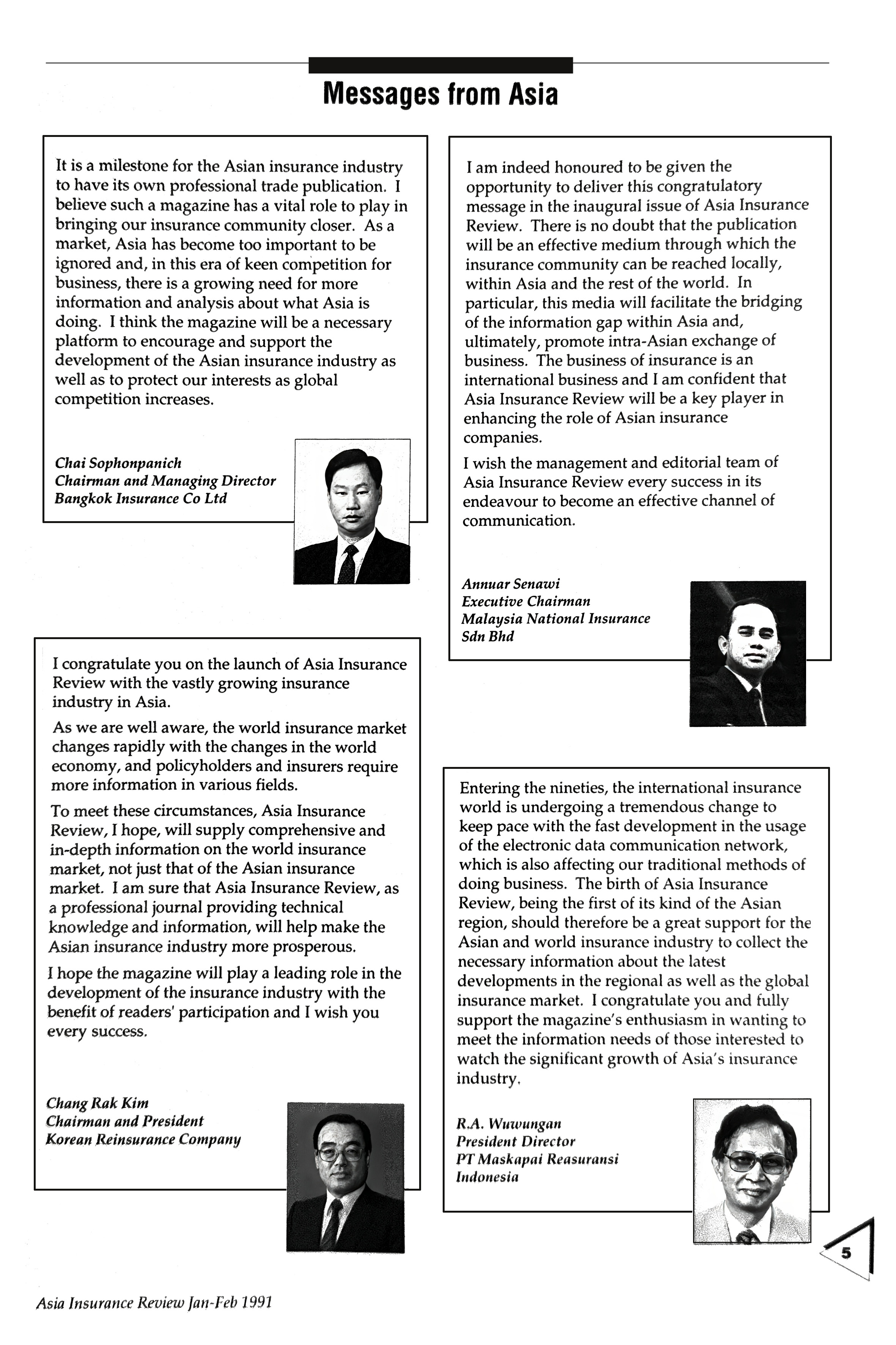
It is a milestone for the Asian insurance industry to have its own professional trade publication. I believe such a magazine has a vital role to play in bringing our insurance community closer. As a market, Asia has become too important to be ignored and, in this era of keen competition for business, there is a growing need for more information and analysis about what Asia is doing. I think the magazine will be a necessary platform to encourage and support the development of the Asian insurance industry as well as to protect our interests as global competition increases.
Chai Sophonpanich
Chairman and Managing Director Bangkok Insurance Co Ltd
I congratulate you on the launch of Asia Insurance Review with the vastly growing insurance industry in Asia.
As we are well aware, the world insurance market changes rapidly with the changes in the world economy, and policyholders and insurers require more information in various fields.
To meet these circumstances, Asia Insurance Review, I hope, will supply comprehensive and in-depth information on the world insurance market, not just that of the Asian insurance market. I am sure that Asia Insurance Review, as a professional journal providing technical knowledge and information, will help make the Asian insurance industry more prosperous.
I hope the magazine will play a leading role in the development of the insurance industry with the benefit of readers’ participation and I wish you every success.
Chang Rak Kim
Chairman and President Korean Reinsurance Company
I am indeed honoured to be given the opportunity to deliver this congratulatory message in the inaugural issue of Asia Insurance Review. There is no doubt that the publication will be an effective medium through which the insurance community can be reached locally, within Asia and the rest of the world. In particular, this media will facilitate the bridging of the information gap within Asia and, ultimately, promote intra-Asian exchange of business. The business of insurance is an international business and I am confident that Asia Insurance Review will be a key player in enhancing the role of Asian insurance companies.
I wish the management and editorial team of Asia Insurance Review every success in its endeavour to become an effective channel of communication.
Annuar Senawi
Executive Chairman Malaysia National Insurance Sdn Bhd
Entering the nineties, the international insurance world is undergoing a tremendous change to keep pace with the fast development in the usage of the electronic data communication network, which is also affecting our traditional methods of doing business. The birth of Asia Insurance Review, being the first of its kind of the Asian region, should therefore be a great support for the Asian and world insurance industry to collect the necessary information about the latest developments in the regional as well as the global insurance market. I congratulate you and fully support the magazine’s enthusiasm in wanting to meet the information needs of those interested to watch the significant growth of Asia’s insurance industry.
R.A. Wuwungan
President Director of PT Maskapai Reasuransi Indonesia
|
| With Asia Insurance Review celebrating its 35th anniversary this year, we felt that it was apt for us to look back at our earlier issues and see how we have developed as a publication, and also get snapshot of the industry from years past. This month, we take a look at an interview with Mr R N Malhotra in the March-April 1994 issue of Asia Insurance Review. The interview, conducted by AIR veteran Jimmy John, looked at the suggested reforms of the Indian insurance sector by a special committee led by Mr Malhotra, on whose recommendations caused the sector to open up in 2000. AIR was one of the few foreign publications to sit down with Mr Malhotra and was the beginning of our long-standing involvement in India. |
|
The article is reprinted, as is.
|
Focus On
Mr R N Malhotra of India
By Mr Jimmy John, Asia Insurance Review’s Correspondent In India
In an exclusive interview with Asia Insurance Review in New Delhi, Mr RN Malhotra, Chairman of the Committee that examined the possibility of reforms in the Indian Insurance sector, said that the insurance industry in India must be opened up for competition. He felt that there was a need to open up the industry to the private sector in order to promote competition and better service to the consumer of insurance services.
Strengths and weaknesses of the indian industry
Mr RN Malhotra, ex-Governor of the Reserve Bank of India, appointed to head the Committee formed in April 1993 by the Government of India, is of the opinion that the industry has its own strengths and weaknesses. The Indian insurance industry has a “large presence throughout the country and has built a larger reservoir of trained manpower”. He was also of the view that the industry had a strong marketing force and a strong financial position.
Reviewing the weaknesses of the market, Mr Malhotra said that it flows from the fact that “it was a monopoly industry”. He also felt that there has been a measure of complacency which was sometimes reflected in “inadequate response to customer needs”.
He was very critical of the high costs of operation and obsolete technology that was the hallmark of the industry here.
According to him these weaknesses “could be overcome” if the industry was exposed to competition.
Future prospects
When asked on the future prospects of the LIC and GIC, Mr Malhotra was very emphatic that the companies “were in a position to face competition”. So far as the general insurance companies (ie. the four subsidiaries of the GIC) were concerned, the Committee has recommended that they should be de-linked from the General Insurance Corporation of India (GIC) and function as independent competing companies. He felt that the companies had “adequate experience” and personnel to effectively operate in a more competitive environment.
As for the LIC, the Committee has recommended re-organizing of its working. This he said would be possible only if the LIC’s seven zonal offices start functioning as head-offices, for insurance and related operational matters.
At the same time the Committee has also suggested that 50% of Government holdings in the insurance companies should be sold to the general public. This would ensure that the insurance companies would be “truly Board-run institutions”.
|
 |
Restructuring of the market
Looking at the prospect of restructuring of the market Mr Malhotra stated that he has suggested re-structuring of the companies. He felt that the LIC should function in a different manner and very strongly suggested technological upgradation in the entire industry. The need for comprehensive computerisation was felt for handling operations and a strong “management information system”. This he felt could be accomplished in a period of 18 months to 2 years, bringing about a major difference in “efficiency and ability to serve its constituents better”.
Areas for improvement
When asked if there were any areas that needed further scrutiny, Mr Malhotra said that there were some lines of business that needed further development. “Personal lines of business have been under-addressed; pension funds have not been very developed, investment-linked schemes are an area which has a great potential and which remains to be fully tapped”. Similarly, term insurance business also remains to be tapped. He felt that the insurance market was “quite large” and with overall growth in the economy there would be tremendous growth for more insurance work in the future.
Relationship between the insurance industry and the controller of insurance
Mr Malhotra stated that the Committee was of the view that the “regulatory framework needs strengthening”. He felt that due to nationalisation of the insurance industry, regulation has been “under-emphasised for a long time”. He felt that the Controller of Insurance was not exercising his powers because of special dispensation in favour of the LIC and the GIC.” The Committee has recommended that all the powers which rest in the Controller of Insurance be restored to him and he should start functioning immediately outside the Ministry of Finance. He also felt that in due course a regulatory body must be set up in the same lines as the Securities and Exchange Board of India (SEBI).
The fate of the recommendations
Asked whether his recommendations would be accepted, Mr Malhotra was of the view that the tremendous response he was receiving from the media and the general public was very “supportive”. He said that it was up to the Government to decide but stated that there was strong resentment by the Trade Unions and employees representative to his suggestions. He felt that as it was a committee set up be the Government, due consideration would be given to its recommendations. A
|