As part of our 35th anniversary, this article looks back at a defining moment for Japan’s insurance industry — the landmark 1995 reform that reshaped the market and set it on a path toward liberalisation and global integration.
By Reva Ganesan
The Insurance Business Act Japan underpins Japan’s modern insurance framework. Introduced in 1995 and coming into force in 1996, it was the biggest shake-up of the sector in decades, moving the market away from a tightly controlled system towards something more open and competitive.
It set out the core rules around licensing, solvency, governance and conduct, under the oversight of the Financial Services Agency (FSA) Japan.
At the same time, it gave insurers more room to design products and compete, while strengthening safeguards for policyholders.
In September 1995, Asia Insurance Review briefly covered the news.
Japan: New Insurance Law to be implemented in April 1996
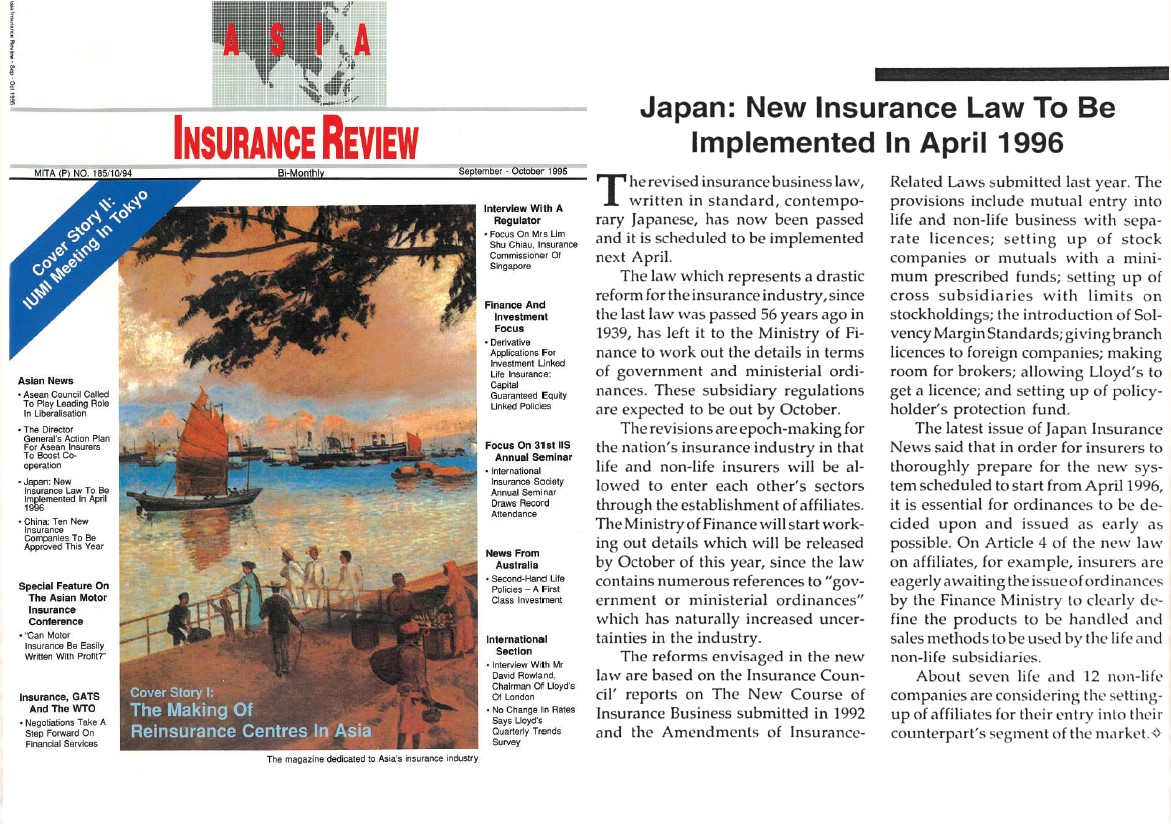
The revised insurance business law, written in standard, contemporary Japanese, has now been passed and it is scheduled to be implemented next April.
The law which represents a drastic reform for the insurance industry, since the last law was passed 56 years ago in 1939, has left it to the Ministry of Finance to work out the details in terms of government and ministerial ordinances. These subsidiary regulations are expected to be out by October.
The revisions are epoch-making for the nation’s insurance industry in that life and non-life insurers will be allowed to enter each other’s sectors through the establishment of affiliates. The Ministry of Finance will start working out details which will be released by October of this year, since the law contains numerous references to “government or ministerial ordinances” which has naturally increased uncertainties in the industry.
The reforms envisaged in the new law are based on the Insurance Council’ reports on The New Course of Insurance Business submitted in 1992 and the Amendments of Insurance- Related Laws submitted last year. The provisions include mutual entry into life and non-life business with separate licences; setting up of stock companies or mutuals with a minimum prescribed funds; setting up of cross subsidiaries with limits on stockholdings; the introduction of Solvency Margin Standards; giving branch licences to foreign companies; making room for brokers; allowing Lloyd’s to get a licence; and setting up of policyholder’s protection fund. A
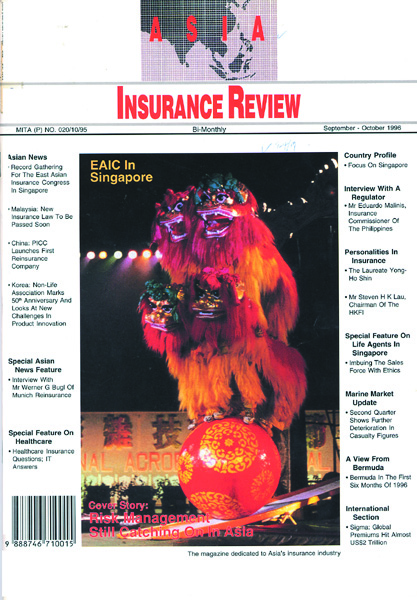
In AIR’s 1996 issue, we followed up on the news.
New Non-Life Chairman to Focus on Changes and Harmonisation
Mr Takeo Inokuchi, newly elected as Chairman of the Marine and Fire Insurance Association of Japan, has set the theme of his stewardship of the non-life body as changes and harmonisation to help the Japanese general insurance companies cope with and progress with the wide-ranging reforms introduced by the authorities.
In his inaugural address on 28 June, Mr Inokuchi said: “I see this year as a year of “changes and harmonisation” at the threshold of the enforcement of the new Insurance Business Law. As Chairman of the Association, I intend to fulfil my duties throughout my tenure so that our non-life insurance industry can be further relied upon by consumers and society.”
Referring to the enforcement of the new Insurance Business Law as forcing the non-life insurance industry to undergo such changes as mutual entry between life and non-life insurance businesses, introduction of an insurance brokerage system and de-regulation of insurance products and premium rates, he said: “Our non-life insurance industry will make every effort to create new insurance business by effectively coping with these changes based on the principle of self-responsibility by each company.”
He also said: “It will become increasingly important for our industry to ensure efficiency and fairness in business operations in order to provide consumers with a stable supply of moderate-priced insurance products through fair competition which is expected to result from the enforcement of the new Insurance Business Law.
He concluded that in the year of “changes and harmonisation”, “I will do my best to ensure that our non-life insurance business can enjoy public trust through operating business faith fully based on the new Insurance Business Law”. A
In 2006, FSA Japan Deputy Commissioner for International Affairs Mr Nobuyoshi Chihara gave his first interview with Asia Insurance Review since assuming his role. He outlined several corrective measures that have been put in place to improve transparency and corporate governance in the Japanese market. At that time, the market was made up of 38 life and 48 non-life companies. Now, in 2026, the market has 41 life and 57 non-life companies.
Interview with the Regulator: Improving transparency and corporate governance
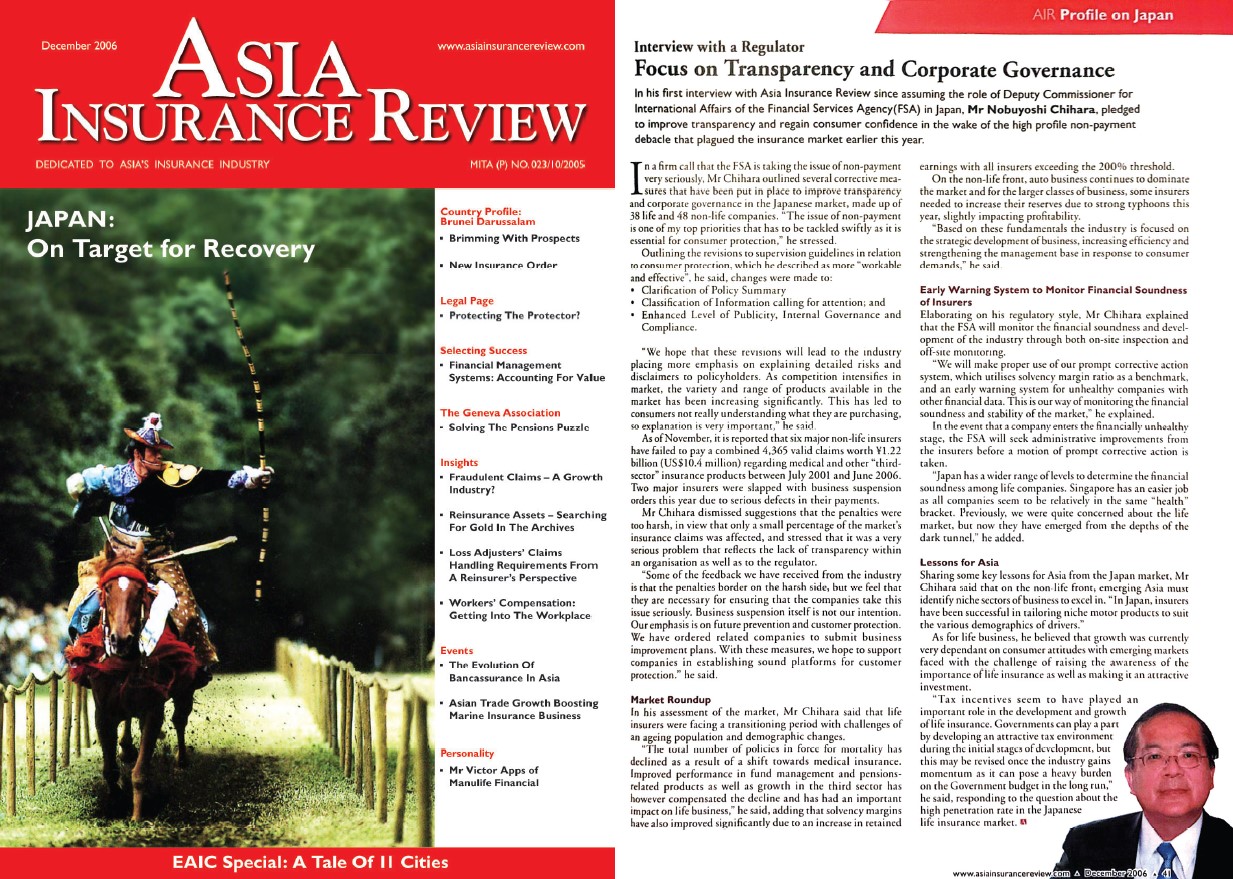
Outlining the revisions to supervision guidelines in relation to consumer protection, Mr Chihara described the changes at that time as more “workable and effective.” He noted that revisions were made in the following areas:
- Clarification of policy summaries
- Classification of information requiring attention
- Enhancement of publicity, internal governance, and compliance
He added, “We hope these revisions will encourage the industry to place greater emphasis on clearly explaining detailed risks and disclaimers to policyholders. As competition in the market intensifies, the variety and range of products have increased significantly. This has resulted in consumers not fully understanding what they are purchasing, making clear explanations essential.”
In his assessment of the market at that time, Mr Chihara said that life insurers were facing a transitioning period with challenges of an ageing population and demographic changes.
He also highlighted that emerging Asian markets could learn from Japan by focusing on niche segments in non-life insurance, noting that Japanese insurers have succeeded by tailoring motor products to different driver demographics. A
In 2013, we covered how the FSA was working to boost the financial strength of Japan’s insurers and considering the introduction of a new economic value-based solvency regime, with Assistant Commissioner for International Affairs Naruki Mori offering insights into the agency’s broader efforts to keep the industry in top shape.
FSA looks to further boost insurers’ solvency
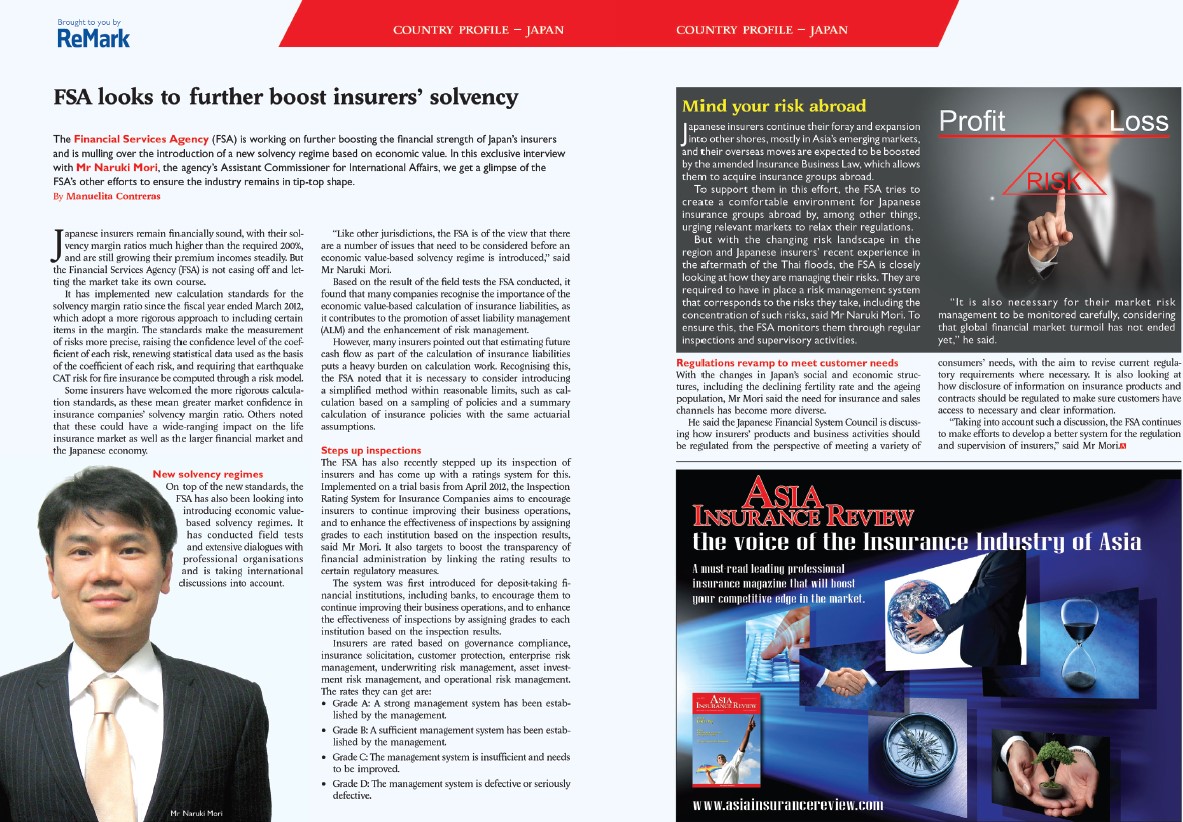
Japan’s FSA has strengthened oversight of insurers through stricter solvency margin ratio standards introduced from FY2012, making risk measurement more precise and requiring model-based calculation of earthquake catastrophe risk. While these tougher standards have improved market confidence in insurers’ financial soundness, some in the industry are concerned about broader impacts on the life insurance sector and the wider economy.
At the same time, the FSA is exploring an economic value-based solvency regime. While insurers see its benefits for risk and asset-liability management, they also say it is complex and costly to calculate, so the FSA is considering simpler methods.
In parallel, the FSA has stepped up inspections by introducing an Inspection Rating System on a trial basis in April 2012. This system grades insurers based on inspection results to encourage better business practices, improve regulatory effectiveness, and boost transparency by linking ratings to regulatory actions. A
3 years later in our March 2016 issue, we interviewed JFSA’s Messrs Tomoyuki Furusawa and Takashi Hamano on how the FSA remained confident in the market’s resilience despite global headwinds and Nat CAT losses, while focussing on consumer protection and strengthening the financial system amid emerging risks such as cybersecurity and FinTech.
Interview with the regulator: Forging strength from inside-out
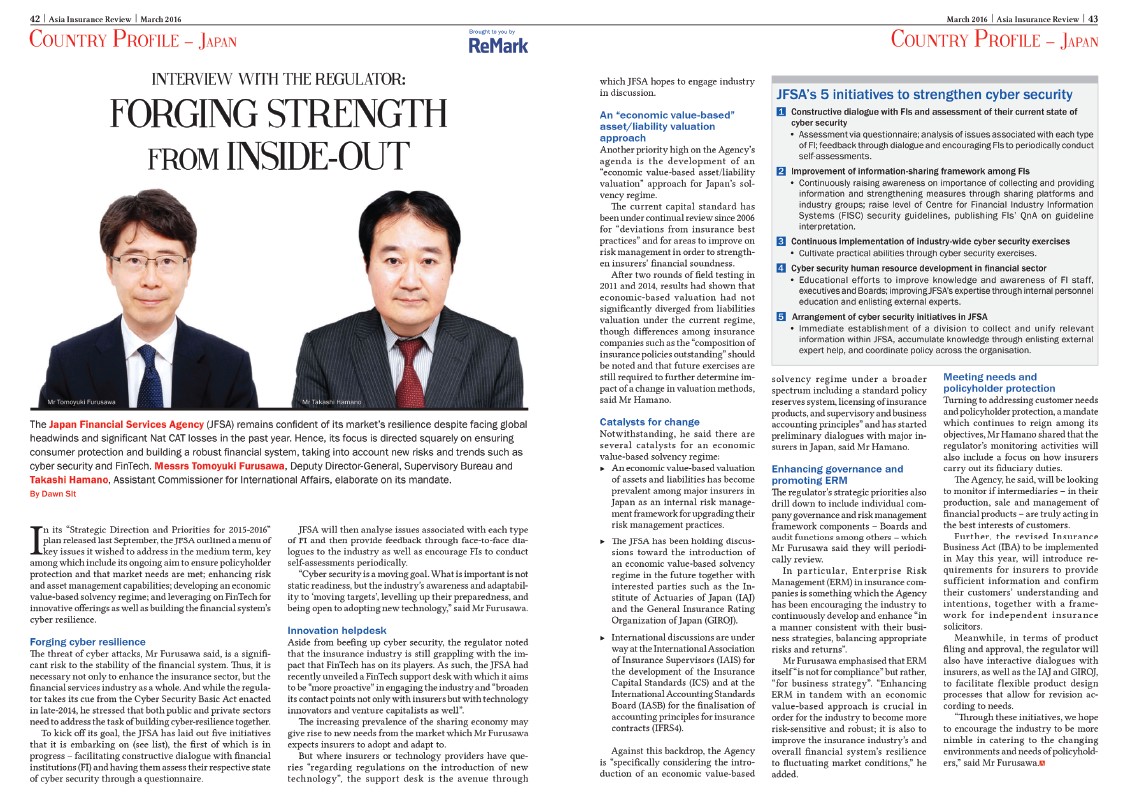
JFSA set out key priorities for 2015 and 2016 focussed on strengthening policyholder protection, improving risk and asset management, developing an economic value-based solvency regime and embracing FinTech while enhancing cybersecurity across the financial system.
Cyber risk was identified as a major threat to financial stability, prompting the JFSA to push for industry-wide resilience through closer collaboration between public and private sectors. It launched initiatives including engaging financial institutions through surveys, analysing their cybersecurity readiness and encouraging continuous self-assessment and adaptability to evolving threats.
At the same time, the JFSA recognised the growing impact of FinTech and established a support desk to engage more actively with insurers, tech firms and investors. This is meant to support innovation, answer regulatory questions, and help the industry keep up with trends like the sharing economy. A
In September 2020, our ex-editorial director Mr Paul McNamara sat down with FSA’s Norio Hida to discuss why economic value-based solvency regulation is so important in one of Asia Pacific’s most mature and sophisticated insurance markets. Other regulatory insights were laid out too.
Regulatory Insights
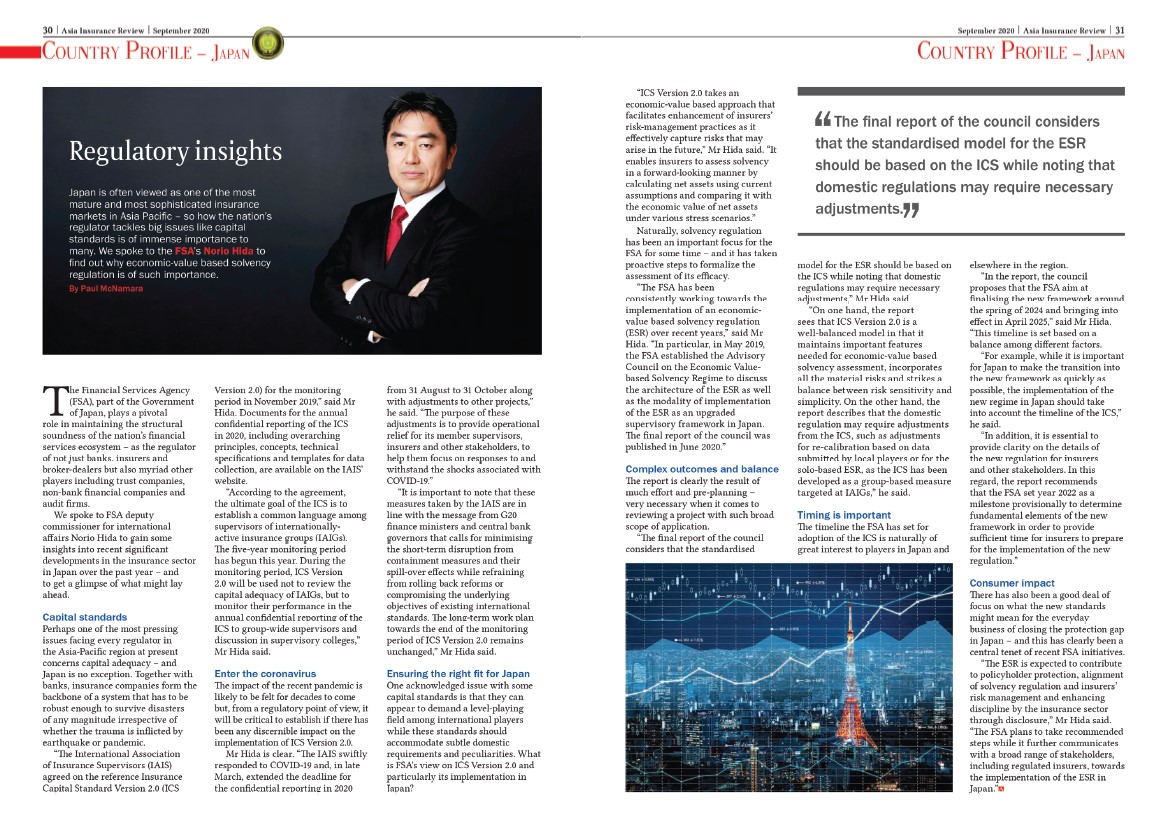
“Perhaps one of the most pressing issues facing every regulator in the Asia-Pacific region at present concerns capital adequacy, and Japan is no exception. Together with banks, insurance companies form the backbone of a system that must be robust enough to survive disasters of any magnitude irrespective of whether the trauma is inflicted by earthquake or pandemic.
“The International Association of Insurance Supervisors (IAIS) agreed on the reference Insurance Capital Standard Version 2.0 (ICS Version 2.0) for the monitoring period in November 2019,” said Mr Hida. Documents for the annual confidential reporting of the ICS in 2020, including overarching principles, concepts, technical specifications and templates for data collection, are available on the IAIS’ website.
“According to the agreement, the goal of the ICS is to establish a common language among supervisors of internationally active insurance groups (IAIGs). The five-year monitoring period has begun this year. During the monitoring period, ICS Version 2.0 will be used not to review the capital adequacy of IAIGs, but to monitor their performance in the annual confidential reporting of the ICS to group-wide supervisors and discussion in supervisory colleges,” Mr Hida said. A
One of the most recent articles on the Japanese regulatory market, our August 2022 issue had FSA’s Mr Shigeru Ariizumi share some insights on the challenges and opportunities facing insurers in Japan post-pandemic and highlight the main policy issues for the year ahead.
Insurance Regulation in Japan
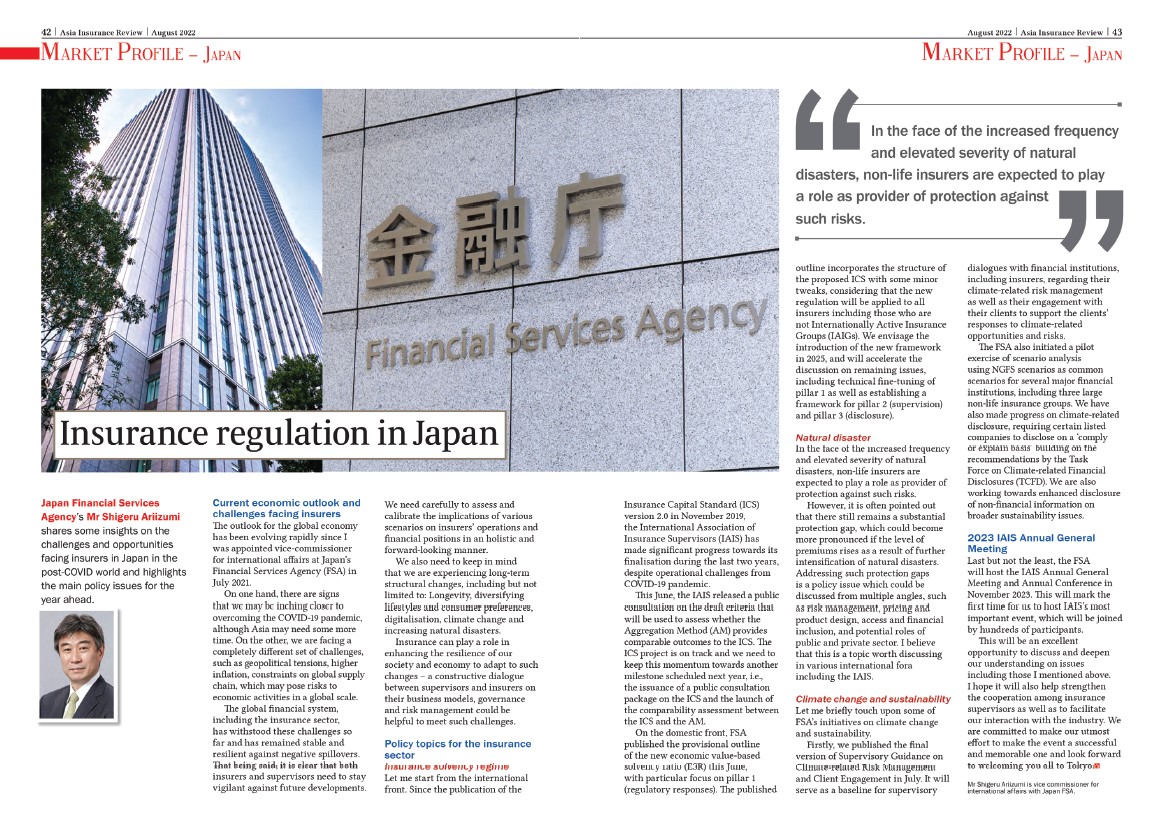
Mr Ariizumi said, “On one hand, there are signs that we may be inching closer to overcoming the COVID-19 pandemic, although Asia may need some more time. On the other, we are facing a completely different set of challenges, such as geopolitical tensions, higher inflation, constraints on global supply chain, which may pose risks to economic activities in a global scale.”
He also said the global financial system, including the insurance sector, has withstood these challenges so far and has remained stable and resilient against negative spillovers.
“That being said, it is clear, that both insurers and supervisors need to stay vigilant against future developments. We need carefully to assess and calibrate the implications of various scenarios on insurers’ operations and financial positions in a holistic and forward-looking manner,” he said. A
Currently in 2026, the FSA is still focussed on strengthening financial stability while actively managing new systemic risks.
A significant priority is the rollout and refinement of Japan’s economic value-based solvency regime for insurers, which is being aligned more closely with global standards (including the IAIS Insurance Capital Standard).
Besides capital reform, the regulator is also tightening supervision across financial institutions through more granular monitoring of risks such as private credit exposure, interest rate sensitivity, and market volatility, reflecting concerns about global financial stress spillovers into Japan’s banking and insurance sectors. A